Miniature Ordnance Review looks at the world of historical and fantasy miniatures wargaming and model building. From 15mm Flames of War, to Warhammer 40K, to 1/35th scale tanks, with some potential surprises on the horizon - you'll find them here!

Thursday, July 10, 2014

Martian Front - Mark III Tank Progress

As I mentioned in an earlier blog, the All Quiet on the Martian Front steam tank sprue is very modular allowing you to build one of a myriad of vehicles.  Although only the Mark I, II, and III are detailed in the current rule book, if you go over to the Alien Dungeon website they have a tutorial with instructions on how to build several alternative variants of the tanks including HMG armed Mark III's and the Mark IIB.  To my knowledge the rules for these variants have not yet been published, but I expect they'll show up soon.

I've now built several Mark II tanks and have moved on to a couple of Mark III tanks as well.  While I sincerely applaud Alien Dungeon for going with plastic from the outset, there are several problems with the molds.  One issue common to all of the steam tanks is misalignment at the rear of the vehicle.  As you can see in the photo below, the smokebox doesn't line up well, nor does the inner track unit plate on the right side.  These issues are easy enough to fix with a little judicious sanding.


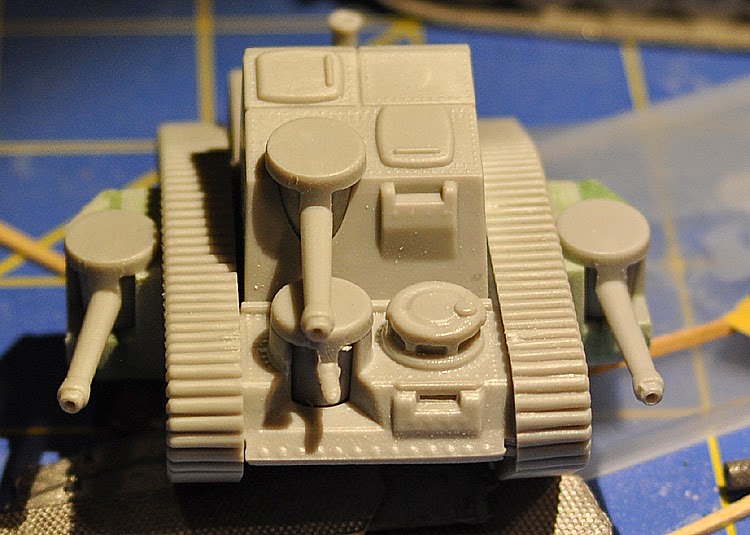
The sponsons on the Mark III (and other models) also suffer some severe gaps between the two sponson halves.  As you can see from the photo below there are severe gaps to the top and bottom which require putty to fill.  The front also requires putty, though I left the line on the back as it does give the appearance of armor plates meeting.


In general I've also found that the alignment aids on all of the kits have been too large (whether they be pins or tabs), and all have required some amount of sanding before the pieces could mate properly.  While the end result still looks excellent, it does require extra time that could have been avoided if the tolerances were set more accurately.

While somewhat annoying to have to fix, the miniature actually does build up quite nicely.  Below is the first Mark III I finished assembling.  In the top and front views you can see the putty on the sponsons:


Because the guns are plastic, cleaning them up and hollowing out the tips is very easy providing a very nice looking final product.  I'm planning on getting all 15 of my American Steam Tanks together before having a marathon painting session (hopefully when I'm on vacation next week).

Flames of World War I - Paint for Tanks

Unless you've been under a rock, you've likely heard of the upcoming World War I range for Flames of War.  It looks like Battlefront has put together a couple of decent army deals to help players get started. Battlefront's first foray into the war is actually fairly late in the conflict where the more familiar combined arms warfare was starting to take hold. I made a few writing contributions to this effort, and I'm honestly looking forward to it.

The tank was born during World War I, so literally everything about this cornerstone of modern ground combat was in its infancy, and that includes paint and camouflage.  I'd been struggling to find good paints for my World War I armor as the Vallejo colors typically come out just a little off to my eye - at least on vehicles.  On infantry they're the gold standard.  I was therefore extremely excited when I went over to the Ammo of Mig site and saw their (new?) paint set for World War I British and German tanks.

Yes - I already have some on order... now I'm ready to get my grubby hands on the miniatures!

Saturday, July 5, 2014

All Quiet on the Martian Front - Steam Tank Mk II/III Sprue

After a communication and shipping snafu, the first batch of my All Quiet on the Martian Front miniatures from the highly successful Kickstarter Campaign finally arrived... just in time for me to have to go to Japan on business.  Two weeks later I've finally been able to crack into the miniatures.  I've started with the American Steam tanks.  One of the stretch goals was reached so rather than these being delivered in resin and metal, they're injection molded plastic.  Because they were able to go with an injection molded plastic frame, you can make several different steam tank variants from one sprue - though you'll still only get one tank per sprue.


The photo above shows the general layout of the steam tank sprue.  I've gone through and labeled everything on it to the best of my knowledge/ability.  For the common Mark II tank, you'll have quite a bit left over. The Mark III tank, with its higher superstructure uses more pieces. Because of the included interior detail, it's clear that the sprue will be used as a basis for several other vehicles as well.


The photo above shows the bottom of the steam tank sprue.  The quality of the engineering and detailing is not quite up to what you'd expect from the larger miniature or model manufacturers.  The rivet detail on the tank is fairly faint, and the overall fit is not spectacular.  Just about every piece takes at least a little work to get it to line up properly.  There is also a fair amount of mold offset on the short smokestacks.  None of the issues with the mold are showstoppers, but be warned that you'll need to do a fair amount of fitting, sanding, and filing to get the tanks together.

The ejector pin marks on all of the bottom pieces are extremely deep. Fortunately they've done a good job of making sure you're unlikely to ever see any of them.  A few of the round pieces may need a little extra work - as will the towing attachment, but otherwise all of the pin holes will be inside sealed portions of the model itself.

Another thing you'll notice about the steam tanks is that for 15mm miniatures they're BIG!  This should be expected for vehicles inspired by World War I-era tanks. The picture below is a side view of a Battlefront Jagdtiger and a ready to paint Mark II Steam Tank - as you can see the lengths of the tanks are quite similar.


The relative level of detailing of the two should also be readily apparent - the detail on the Jagdtiger (even that which I didn't add myself) is very crisp and in high relief whereas the detailing on the steam tank is fainter.  Truth be told, the rivet detail on the steam tank is probably more accurate to the scale, but it makes it more difficult to bring out the detailing with weathering.  It also stands in stark contrast to some of the other detailing on the steam tank which is in strong relief.


The top view above further demonstrates the differences in the level of detailing.  The tracks and hatches on the steam tank are strongly detailed, while the rivets and screens effectively disappear.  I'm planning on doing a fair amount of panel shading on the steam tanks, so hopefully that will better bring out some of the detail.

At this point I have several sprues of tanks - somewhere around 15 if memory serves.  I'm planning on doing at least six as the Mark III, with at least six Mark II - I may even try and bust out a few Mark I tanks if I can better confirm the parts count

Wednesday, June 4, 2014

512 Schwere Panzerjager in Progress

As I mentioned earlier, I'm probably going to be one of the only people who actually fields the 1/512 list (CV) over the 2/512 list (RT) largely because I love the unit history.  Don't get me wrong, I will eventually get Otto in his LEAST favorite AFV and have him wreak mighty vengeance with his lascannon... errr, 12.8cm gun with special rules, but for now I'm interested in fielding Kampfgruppe Ernst. As noted in the WWPD review of the book, 1/512 can get Panzer IV Ausf J and Stug III Ausf G in support along with the anti-aircraft tanks.  At this point, Battlefront lacks a good Stug III Ausf G (late), so at this point I'm opting to go with the Panzer IV Ausf J.

In an earlier blog, I detailed the issue with the running gear on Battlefront's Panzer IV Ausf J.  Yes, I was working up the tanks for this very list in January - actually in December, and I'm still not done!  After taking a long hard look at the Battlefront miniature, I'm not sure they should have included the felt-bellows connected air filter on the Ausf J (the "muffler" or "exhaust" on the right side that sits on the tracks). According to Volume 2 of Spielberger's Panzerkampfwagen IV book, this feature was dropped from Ausf H production in February 1944.  While I suppose it is hypothetically possible that very early production Ausf J may have had it present, later vehicles dropped it, and replaced it with a spare track hanging rack.  So once again I was forced to perform surgery on the miniature.

I didn't have enough spare track lying around to convincingly run track on all four of the Panzer IV Ausf J I need for the list, so I only put the spare track on the commander's vehicle.  In all cases I measured out the vertical supports for the rack and added them using strip styrene.  For the rank and file I then just added piano wire to represent the actual hangers themselves.  You can easily see the rack on the picture below... and a little clean up needed on that replacement idler!  (Ohhhh what you find with primer!)


For the commander's vehicle, I added three columns of two links each, and then used stretched sprue to simulate the ends of the hanging rods.  Contrary to popular belief I am actually not crazy enough to try and drill out the plastic tracks and actually hang them on the rod!  I've still got some final clean-up to do on this guy as well.


Even the Jagdtigers of 1/512 aren't stock.  The unit added machine gun mounts to the rear deck to provide limited AA defense.  It would be an absolute tactic of desperation, which is why we didn't add it to the arsenal entry for the 1/512 Jagdtigers.  The Mount looks simple but actually was fairly involved to create. The core is a piece of piano wire.  The base is a couple of discs of styrene cut out using a punch and die set with a hole drilled in the middle to allow it to slide over the piano wire.  Then I put a length of brass tubing over the wire leaving a small gap at the top.  The tip is a piece of styrene rod sanded back to the right thickness.  Next step is to actually add the gun, which is in my bits box somewhere!


Notice I've also added tow cables to the Jagdtigers, as Ernst's group still had his.  They were missing a lot of the track guards, though!  I have a few more final details to add and then these too will be ready to paint!

Last but not least, here's a group shot of what I have just about ready to paint for this army.


I'm still debating what all of the support choices will be, but I'm definitely including some Volksturm.  Once there are good Stug III Ausf G (late) miniatures available from Battlefront, I'll add those to the army as well. It's unlikely I'll ever be able to field the whole thing together, but at least I'll have it!

Accurizing Your Ostwind - Part 2

A little over a week ago, I posted my initial work at improving the Battlefront Ostwind miniature.  At that point I'd done most of what I wanted to do, but I hadn't corrected the hull hatches because I hadn't been able to get one to cast up well enough to work.  I've since fixed that little issue!

As you can see in the shot below, I've cast a copy of the hatch to use as a donor for the vehicle.  I then sanded off the existing machine gunner's hatch and replaced it with the resin cast one in the correct orientation for the Ostwind.


Here's a group photo from another angle showing the orientation of the hatches.  I did have to re-scribe the line between the front hull armor plate and the top armor.


So far I've converted three, which is probably all I'm going to run for my 512th army at any one time.  I have at least one more Ostwind still in the blister that will undoubtedly call to me some day.

Tuesday, June 3, 2014

Battlefront's New Plastic Sd. Kfz. 251/1 Ausf D

So I finally got my hands on the new Battlefront plastic Panzergrenadier Platoon (GBX76).  I'm still going through the actual figures, though at first blush they look good.   What I really wanted to take a good look at were the plastic halftracks.  New plastic Sd Kfz 251/1 Ausf D models are included both in this set, and in the Panzergrenadier HQ (GBX75) set as well.   Given that so far Battlefront's plastic miniatures have been a bit of a mixed bag, I was anxious to see in person how these looked.  

I'll be open and honest up front - for the most part I'm not a "good enough" modeler.  There are a lot of items which have been wrong or oversimplified on many of Battlefront's miniatures.  The same can be said of many competing solutions as well. The running gear of any vehicle has been one key area where details have often been either incorrect or over-simplified for the scale.  Naturally that's the first place I looked on these new halftracks.

The verdict - they're brilliant!  The interleaved road wheels and idler have the appropriate alternating eight and six lightening holes as seen on the real thing.  The drive sprocket is also accurate in its number of spokes as well (seven full radius, seven half radius if you're counting!).  The front wheels have the correct number of lug nuts, and in general the rest of the detailing is appropriate to the scale.  

All in all Battlefront has done an exceptional job capturing this ubiquitous vehicle's details accurately.  I'll continue to check the miniatures as I build them up and will post a construction review in a few weeks. Really I only have one regret picking up this set... now I need several more!!!

The Bridge at Remagen - Miniatures and Movies

With the upcoming Flames of War book covering the battles for the Ludendorff Bridge at Remagen, I've been madly working on and converting miniatures to accurately represent one of the units from Kampfgruppe Hudel (and as soon as I find the charger for my dead camera battery I'll have some new posts there as well). While painting, I generally like to drop in a war movie for background while I work.  This time around I figured I'd watch The Bridge at Remagen, the 1969 David L. Wolper release - it just seemed appropriate.

I hadn't watched the film in quite a while, but I remembered that it played a bit fast and loose with the actual events surrounding the capture of the Bridge.  Given I'd done a lot of research on the battle for the upcoming book, I was really able to look at the movie with a critical eye in a way I hadn't been able to do in the past. Sometimes I'm not sure whether or not that's a "good thing" as invariably when I take a critical look at most war movies, they fall short.

As with most war movies of the era, The Bridge at Remagen falls incredibly short on many levels. Wikipedia refers to the movie as a "highly-fictionalized version of actual events," and in many ways that is an understatement.  The actual assault on the bridge itself was nothing like what is depicted in the movie. Casualties during the initial assault were light to non-existent, though clearing the ridge on the eastern bank was costly. The charges weren't detonated during the assault, but rather before the assault.  I could go on and on, but I think you get the picture.

However, one important fact to remember about this war film, and many of the World War II films of the late 1960's and early 1970's was that the story wasn't about World War II, it was about the increasingly unpopular war in Vietnam.  Other films of the era, like Kelly's Heroes, share similar themes - of inept officers pushing worn out troops forward in a hopeless quest for glory using the perception of a futile conflict as a backdrop.

That being said, I really love Kelly's Heroes while Bridge gets far fewer stars (and far fewer viewings).  For me the difference is that Kelly's Heroes doesn't pretend to be anything other than a work of fiction.  There was no such action in World War II, and you're pretty much aware of that fact from the outset.  The Bridge at Remagen, however, purports to be the story of an actual battle in World War II.  Instead it co-opts the place, time, and equipment to tell a completely different story, and that's where I start taking issue.

By taking a battle which was generally well-conducted and turning it into a political statement by twisting the facts seems more than a little dishonest. Given the producers wanted to tell a story that would resonate with war-weary Americans using World War II as a backdrop, there are plenty of actual stories in World War II that would work just fine.  The Battle of the Hürtgen Forest would do well.  The battle of the Winter Line in Italy is another good example.

That being said, many of the action scenes were good.  Most of the equipment used while not entirely accurate to the particular battle (at least on the American side), it was at least of World War II vintage.  The movie also does a good job of trying to examine both the American and the German points of view (though there are many inaccuracies on the German side as well).  If you're looking for a Vietnam action/war movie - The Bridge at Remagen is not bad.  If you're looking for an accurate World War II film, however, you'll have to look elsewhere!